

The promise of personalized education—where content adapts to the individual student’s pace, style, and knowledge gaps—has finally been realized through the power of Artificial Intelligence. In 2025, AI-powered mobile applications have moved past simple automation to become true Intelligent Tutoring Systems (ITS), providing hyper-individualized support to both students and educators.
These top AI apps are not just homework helpers; they are transforming the learning process, ensuring every student has an always-available, infinitely patient co-pilot guiding their academic journey.
1. Khanmigo (Khan Academy’s AI Tutor and Assistant)
Built by the trusted nonprofit Khan Academy, Khanmigo stands out because it is ethically designed with a laser focus on learning, not just giving answers.It integrates directly with Khan Academy’s massive library of world-class content.
- Personalized Tutoring: Unlike generic chatbots, Khanmigo acts as a Socratic guide. If a student is stuck on an algebra problem, it uses guiding questions and hints, leading the student to the solution without simply revealing the answer, thus fostering critical thinking.
- Teacher Assistant Functionality: For educators, Khanmigo simplifies differentiation. It can quickly generate rubrics, lesson plans, quiz questions, and leveled readings based on specific unit plans, saving hours of administrative time.
- Safe and Controlled Environment: It is explicitly designed to minimize the risk of academic dishonesty, making it one of the most trusted AI tools for school-wide implementation.
2. ScribeMind / Socratic by Google (Adaptive Study Companions)
These tools revolutionize how students tackle difficult concepts and organize their study materials, adapting the format of instruction to the student’s needs.
- Socratic (Homework Helper): Students can snap a photo of a math equation, history question, or physics diagram, and the AI instantly provides step-by-step explanations, visual solutions, and breakdown of concepts. This is crucial for students who need instant, visual reinforcement outside of class hours.
- ScribeMind (Habit-Based Learning): This next-generation study app tracks a student’s performance and preferred learning style (e.g., visual, auditory). If a student struggles with history, ScribeMind won’t just recommend more paragraphs; it might switch to an interactive timeline, a brief explainer video, or an audio summary, readjusting the content delivery in real-time.
3. Wolfram Alpha (Computational Knowledge Engine)
Wolfram Alpha is the gold standard for STEM (Science, Technology, Engineering, and Mathematics) education, using AI to solve complex problems and provide context.
- Step-by-Step Solutions: It provides not just the answer, but the complete, methodical, step-by-step process for problems in calculus, engineering, physics, and chemistry.
- Computational Data: It can calculate, compare, and display data on virtually any topic—from historical economic trends to molecular weights—acting as a personalized, always-available computational research assistant.
4. Adaptive Language Platforms (e.g., Duolingo, LingoLoop)
Language learning platforms utilize AI to move beyond static, memorized phrases and focus on conversational fluency.
- Real-time Correction and Practice: Apps like Duolingo and the emerging LingoLoop use advanced speech recognition and Natural Language Processing (NLP) to evaluate pronunciation, vocabulary, and grammar in real-time.
- Dynamic Lesson Adjustment: If a user performs better in written exercises than speaking practice, the AI will automatically increase the difficulty of the writing prompts while providing more focused, guided conversational practice to address the specific fluency gap.
5. Otter.ai & Notion AI (Note-Taking and Synthesis)
These tools utilize AI to streamline the administrative burdens of learning—note-taking, organization, and summarization—freeing students to focus on retention.
- Otter.ai (Intelligent Transcription): Transcribes lectures and meetings in real-time, identifies speakers, and automatically generates concise summaries and searchable action items, ensuring students never miss a critical point due to note-taking fatigue.
- Notion AI (Knowledge Synthesis): Embedded directly into the organizational platform, Notion AI can summarize an entire database of lecture notes, draft flashcards based on a project document, or instantly create a study guide by cross-referencing information from different pages.
The Future of the AI-Empowered Classroom
The top AI apps in 2025 demonstrate that the revolution in education is not about replacing the human teacher, but about scaling personalization. These applications provide teachers with the tools to differentiate instruction for 30 students simultaneously and offer every learner access to a private tutor tailored precisely to their needs. By automating the mechanics of learning, AI empowers both students and educators to focus on the higher-order skills of critical thinking, creativity, and deep engagement.
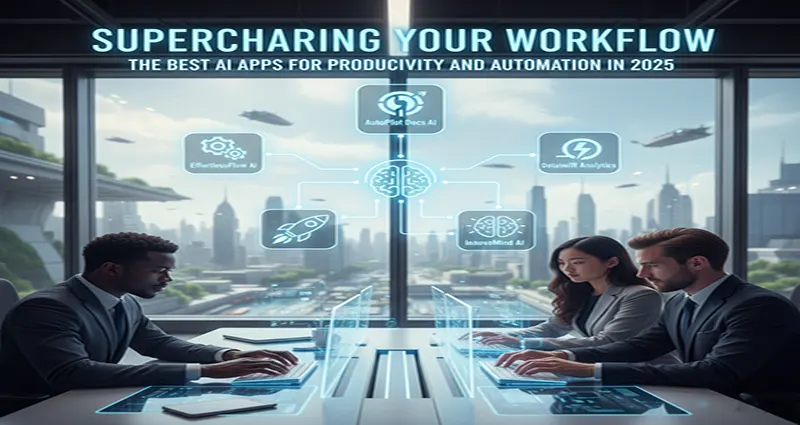
The year 2025 marks a pivotal point where Artificial Intelligence has fully integrated into our daily workflows, moving beyond novelties Read more

Developing an Artificial Intelligence (AI) application is fundamentally different from traditional software development. It's a journey centered around data, algorithms, Read more

The era of slow, manual content production is officially over. In 2025, Artificial Intelligence has seamlessly migrated from the desktop Read more

Artificial Intelligence (AI) has rapidly transitioned from a futuristic concept to an embedded reality. Today, AI is no longer confined Read more