
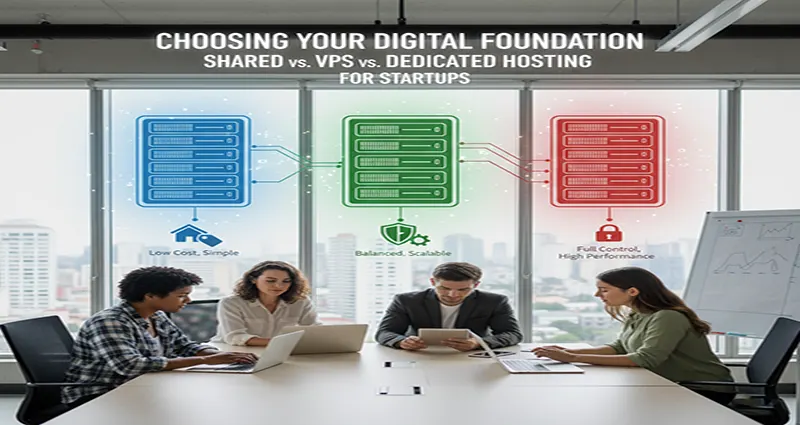
For any startup, the website or web application is its digital storefront, and the hosting solution is the foundation upon which its success is built. Choosing the right type of hosting is a critical decision that impacts budget, performance, security, and the ability to scale.
Here is a comprehensive breakdown of the three primary hosting types—Shared, Virtual Private Server (VPS), and Dedicated—to help a startup select the optimal environment for its stage of growth.
1. Shared Hosting: The Affordable Entry Point
Think of Shared Hosting as renting a room in a large, affordable apartment complex. You have your private space, but you share the communal utilities (CPU, RAM, disk space) with all other residents (websites).
| Feature | Description for Startups |
| 💰 Cost | Lowest. Typically $5–$15 per month. |
| ⚙️ Performance | Basic. Resources are not guaranteed; performance can suffer from the “noisy neighbor effect” (if one site gets a traffic spike, yours may slow down). |
| 🛡️ Security | Lower Isolation. While providers secure the server, you lack control, and security issues with a neighboring site can pose a marginal risk. |
| 💻 Control | Minimal. No root access. The host manages all server maintenance, patching, and security. |
| 🎯 Best For | Idea Validation / Minimal Viable Product (MVP) / Low-Traffic Sites. Great for personal blogs, portfolio sites, or a new business with a limited budget and low expected traffic (under 25,000 monthly visitors). |
Startup Verdict:Start Here! Shared hosting is the perfect, low-risk way to launch your initial online presence and test the market while conserving precious seed capital.
2. Virtual Private Server (VPS) Hosting: The Growth Catalyst
VPS Hosting is the middle ground, often compared to a condominium. You still share a physical server, but virtualization technology partitions it into several private servers. You get guaranteed, dedicated resources within your partition.
| Feature | Description for Startups |
| 💰 Cost | Mid-Range. Typically $20–$90 per month (depending on managed vs. unmanaged). |
| ⚙️ Performance | Good/Consistent. Your dedicated CPU and RAM allocation means your site’s speed and uptime are protected from other users on the same physical machine. |
| 🛡️ Security | High Isolation. Your environment is isolated, significantly reducing the “bad neighbor” risk. You can also implement custom security software. |
| 💻 Control | High. You get root access to your virtual server, allowing you to install custom software, configure the operating system, and fine-tune performance. |
| 🎯 Best For | Scaling Startups / E-commerce / Web Applications. Ideal when you’ve outgrown Shared hosting, need better reliability for an online store, or require specific custom server configurations. |
The Upgrade Signal: A startup should move to VPS when experiencing frequent slowdowns or downtime on their shared plan, or when they hit 50,000+ monthly visitors and need guaranteed speed for conversions.
3. Dedicated Hosting: The Enterprise-Level Powerhouse
Dedicated Hosting is like owning a house: you rent the entire physical server and all its resources are exclusively yours. There is zero sharing of resources.
| Feature | Description for Startups |
| 💰 Cost | Highest. Typically $80–$500+ per month. |
| ⚙️ Performance | Maximum. Unparalleled speed, reliability, and stability, with all server resources (CPU, RAM, bandwidth) at your disposal. |
| 🛡️ Security | Maximum Control. Complete physical and software isolation. Essential for businesses with strict regulatory or high-security compliance needs (e.g., handling sensitive financial or health data). |
| 💻 Control | Complete. Full control over hardware, operating system, and software stack. |
| 🎯 Best For | Large-Scale Operations / Data-Intensive Applications. Only necessary for established startups with massive, mission-critical traffic (hundreds of thousands of visitors daily) or extremely complex, resource-heavy applications. |
Startup Verdict: A Long-Term Goal. Dedicated hosting is overkill and too expensive for most early-stage startups. You should only consider this when all other scalable options (like a high-end VPS or Cloud hosting) have been exhausted.
Key Comparison Summary
| Feature | Shared Hosting | VPS Hosting | Dedicated Hosting |
| Metaphor | Renting a room in a building | Renting a condo unit | Renting an entire house |
| Resource Sharing | All resources shared with many users. | Resources are dedicated within a shared physical server. | Exclusive use of a full physical server. |
| Cost (Relative) | Very Low | Moderate | Very High |
| Scalability | Limited; requires migration to upgrade. | Easy to scale resources up/down quickly. | Requires manual (and costly) hardware upgrades. |
| Management | Host-Managed (Easy) | User-Managed or Managed Option (Requires technical skill) | User-Managed (High technical skill required) |
The Smart Startup Path: The typical and most financially responsible growth path for a startup is to start with Shared Hosting, transition to VPS Hosting once traffic and resource demands increase, and only then consider a Dedicated Server or a true public Cloud infrastructure (like AWS or Google Cloud) at the enterprise level.

Selecting a Dedicated Server for your website can be a challenging task given the number of options available in the Read more

There are different types of web hosting services available to website owners. These include Shared hosting, cloud hosting, Virtual private Read more

You can start a website for free with a free web hosting company. However, free web hosting comes with a Read more

A web hosting service is the organization that provides a space to store a website. The web host manages the Read more