
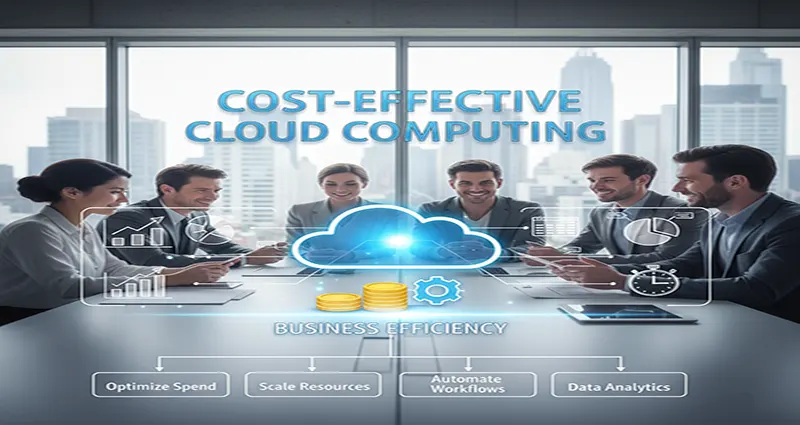
In the age of digital transformation, cloud computing is no longer a luxury but a strategic necessity for businesses of all sizes, promising scalability, flexibility, and reduced capital expenditure (CapEx). However, without careful management, the pay-as-you-go model can quickly lead to spiraling costs, undermining the intended business efficiency. Achieving a true Return on Investment (ROI) from the cloud requires a proactive, strategic approach to cost optimization.
Here are essential, cost-effective cloud computing strategies to ensure your business maximizes efficiency and minimizes unnecessary expenditure.
1. Adopt a FinOps Culture and Gain Visibility
You can’t optimize what you can’t measure. The foundation of cost-effective cloud use is a clear, comprehensive understanding of where every dollar is being spent.
- Implement Cloud Cost Management Tools: Utilize native tools (like AWS Cost Explorer, Azure Cost Management, or Google Cloud Billing Reports) or third-party platforms to gain real-time visibility into your spending.
- Establish Consistent Tagging: Enforce a strict tagging policy for all resources (e.g., tags for Project, Owner, Environment). This allows for accurate cost allocation and attribution to specific teams or departments, fostering accountability.
- Embrace FinOps: Financial Operations (FinOps) is a cultural practice that brings finance, technology, and business teams together to make data-driven spending decisions.It ensures that everyone understands the cost implications of their architectural choices.
2. Optimize Cloud Resource Utilization
Paying for idle or oversized resources is the single biggest contributor to cloud waste. Smart optimization is key to eliminating this unnecessary expense.
- Right-Size Your Instances: Regularly monitor the CPU, memory, and network usage of your virtual machines and databases. Downsize over-provisioned instances to the smallest size that can still handle the workload, and eliminate idle resources (often non-production servers left running overnight or on weekends).
- Leverage Auto-Scaling: Implement auto-scaling policies for variable workloads. This allows your computing capacity to automatically scale up during peak demand and scale back down during low-traffic periods, ensuring you only pay for what you use in real-time.
- Utilize Serverless and Managed Services: Transitioning to serverless computing (like AWS Lambda or Azure Functions) and managed database services removes the operational burden and costs associated with managing underlying infrastructure. You pay only for the compute time consumed by your code executions.
3. Strategically Choose the Right Pricing Models
Cloud providers offer a range of pricing models beyond the default on-demand rates, providing significant discounts for commitment.
- Reserved Instances (RIs) or Savings Plans: For stable, predictable workloads (like core production servers), commit to a 1- or 3-year term using Reserved Instances or Savings Plans. This can yield substantial discounts (often 30-75%) compared to on-demand pricing.
- Spot Instances/Preemptible VMs: Utilize these heavily discounted, spare cloud capacity options for non-critical, fault-tolerant workloads (e.g., batch processing, testing, or development environments). Be aware that these instances can be reclaimed by the provider with short notice.
- Optimize Storage Tiers: Don’t store archives or infrequently accessed data in expensive, high-performance storage. Implement lifecycle policies to automatically move older or cold data to lower-cost tiers (like Cold Storage or Archive Storage), dramatically reducing long-term storage bills.
4. Mitigate Network and Data Transfer Costs
Data transfer costs, particularly egress (data leaving the cloud provider’s network), are often overlooked and can become a major expense.
- Reduce Egress: Design your architecture to minimize data transfers out of the cloud or between regions. Keep data and the applications that process it in the same region where feasible.
- Use Content Delivery Networks (CDNs): For publicly accessible content, use a CDN to cache data closer to your end-users. This drastically reduces the load on your core infrastructure and minimizes costly egress charges from your main cloud environment.
- Compress Data: Employ data compression techniques before transferring data to reduce the volume being moved and the associated costs.
Cost-effective cloud computing is not about cutting corners; it’s about intelligent optimization and governance. By institutionalizing a FinOps culture, diligently rightsizing resources, automating scaling, and strategically utilizing discounted pricing models, businesses can harness the immense power of the cloud to drive operational efficiency and innovation without the fear of financial surprises. It is a continuous process of review and adjustment that ultimately ensures your cloud investment delivers maximum value.

It is not so easy to lead a certain group of students. In fact, it is more convenient for teachers Read more

Absolutely nothing has absolutely brought on additional changes on the planet than science and technologies. In fact, the advent of Read more

Laptop hardware refers to the many physical elements that make up a laptop. As an example, the motherboard, processor, challenging Read more

When arranging a computer system network installation ensure that you have the right technology to complete the job. Make certain Read more