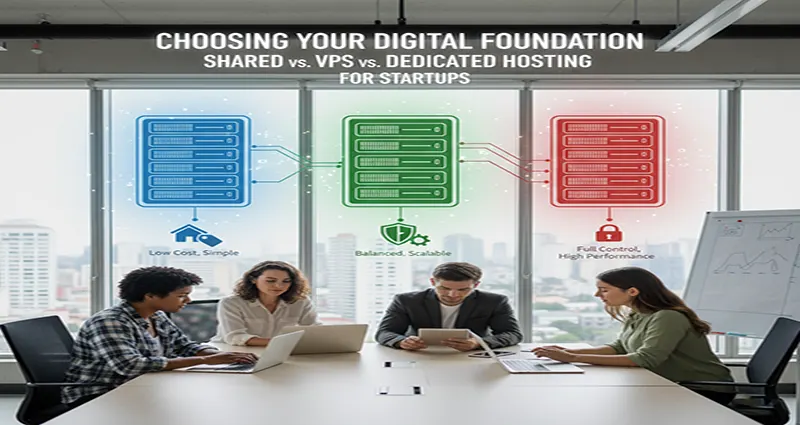
Choosing Your Digital Foundation: Shared vs. VPS vs. Dedicated Hosting for Startups

Choosing Your Digital Foundation: Shared vs. VPS vs. Dedicated Hosting for Startups

For any startup, the website or web application is its digital storefront, and the hosting solution is the foundation upon which its success is built. Choosing the right type of hosting is a critical decision that impacts budget, performance, security, and the ability to scale.

Here is a comprehensive breakdown of the three primary hosting types—Shared, Virtual Private Server (VPS), and Dedicated—to help a startup select the optimal environment for its stage of growth.

1. Shared Hosting: The Affordable Entry Point

Think of Shared Hosting as renting a room in a large, affordable apartment complex. You have your private space, but you share the communal utilities (CPU, RAM, disk space) with all other residents (websites).

FeatureDescription for Startups
💰 CostLowest. Typically $5–$15 per month.
⚙️ PerformanceBasic. Resources are not guaranteed; performance can suffer from the “noisy neighbor effect” (if one site gets a traffic spike,
Read the rest >>>>
From Startup to Scale: How to Attract Clients and Grow Your Web Hosting Business

From Startup to Scale: How to Attract Clients and Grow Your Web Hosting Business

The web hosting industry is highly competitive, but the market’s size and constant need for digital presence offer immense growth potential for focused, agile businesses. Attracting and retaining clients isn’t about competing on price with the giants; it’s about delivering specialized value and unmatched support.

To effectively scale your web hosting business, you must focus on a strategy that combines targeted marketing with superior customer retention.

1. Define Your Unique Selling Proposition (USP) and Niche

Before you spend a single dollar on marketing, you must clearly define why a customer should choose you over a major provider.

  • Focus on a Niche: Don’t be a generalist. Targeting a specific demographic reduces competition and allows you to tailor your entire service.
    • Example 1 (Industry): Managed WordPress Hosting for local photographers or small law firms.
    • Example 2 (Geographic): “The fastest, most reliable host for businesses in [Your City/Region],” emphasizing local support
Read the rest >>>>
Low Cost, High Profit: Profitable Web Hosting Business Ideas

Low Cost, High Profit: Profitable Web Hosting Business Ideas

Starting a web hosting business might sound like a venture reserved for tech giants with massive data centers. However, the modern hosting landscape is dominated by Reseller Hosting and Niche Specialization, making it one of the most profitable online businesses you can launch with a surprisingly low startup cost.

The key to success is avoiding the generic shared hosting market and carving out a valuable, specialized service.

1. The Low-Cost Foundation: Reseller Hosting

The single most critical strategy for a low-startup-cost web hosting business is to avoid building or buying physical servers. Instead, you lease server space from a major hosting provider and re-sell it under your own brand—this is called White-Label Reseller Hosting.

Startup Cost ComponentLow-Cost StrategyEstimated Initial Cost
InfrastructureReseller Hosting Plan. You pay a monthly fee (OpEx) to a parent host, who handles all server maintenance, security, and updates.$15 – $50 per
Read the rest >>>>
Your Brand, Their Servers: Best Reseller Web Hosting Platforms for Small Businesses

Your Brand, Their Servers: Best Reseller Web Hosting Platforms for Small Businesses

Starting a web hosting business or simply adding a recurring revenue stream to your web design/agency services has never been easier, thanks to reseller web hosting. This model allows small enterprises to sell hosting under their own brand (white-labeling) without investing in or managing physical servers.

For small businesses, the best reseller web hosting platform is one that offers a blend of high performance, seamless branding, and robust administrative tools.Your success hinges on the reliability and features of your partner.

Key Features to Look for in a Reseller Partner

Before selecting a platform, a small business must ensure the provider covers the core elements that drive customer satisfaction and streamline operations.

FeatureWhy It Matters for a Small Business Reseller
White-LabelingCritical. The hosting provider’s branding must be completely removed from the client control panel, nameservers, and communications to maintain your professional identity.
WHM/cPanel or PleskIndustry
Read the rest >>>>
Launch Your Empire: How to Start a Web Hosting Business from Scratch in 2025

Launch Your Empire: How to Start a Web Hosting Business from Scratch in 2025

The internet relies on web hosting, and despite the dominance of a few major players, the market is continually refreshed by specialized, customer-focused local and niche providers. Starting a web hosting business in 2025 is less about owning a data center and more about smart reselling, superior support, and razor-sharp specialization.

Here is a step-by-step guide on how to launch your own web hosting company from scratch.

1. Define Your Niche: Don’t Be a Generalist

Trying to compete with giants like GoDaddy or Bluehost on price or scale is a guaranteed path to failure. Your success hinges on solving a specific, unmet need for a defined audience.

Niche Focus AreaTarget Customer ExampleUnique Value Proposition (UVP)
Industry SpecializationSmall Dental or Legal OfficesHIPAA/GDPR compliant hosting with mandatory daily, encrypted off-site backups.
Technology SpecializationFreelance WordPress DevelopersManaged WordPress hosting with built-in staging environments, Git integration, and one-click security
Read the rest >>>>