
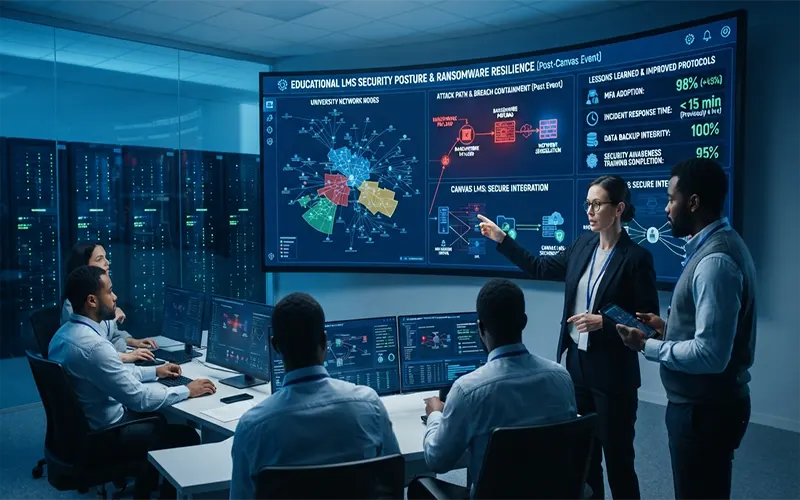
The massive cyberattack and data breach targeting the Canvas Learning Management System (LMS) serves as a watershed moment for institutional IT governance and educational cybersecurity. As centralized learning platforms aggregate massive volumes of sensitive academic records, communication history, and personal disclosures, they have become prime high-value targets for sophisticated extortion groups.
The incident—marked by unauthorized data exfiltration, service defacements during final examination periods, and complex vendor negotiations—offers critical lessons for educational institutions, Chief Information Security Officers (CISOs), and technology vendors alike.
The Anatomy of Educational LMS Vulnerabilities
Educational ecosystems present unique structural challenges that threat actors actively exploit:
- Sprawling Digital Perimeter: Modern LMS platforms do not operate in a vacuum. They are deeply interconnected with third-party Learning Tools Interoperability (LTI) plugins, cloud storage tiers, and external administrative directories.
- The Risk of Secondary Entry Points: Attackers frequently bypass heavily secured core production clusters by probing peripheral, lower-security environments—such as legacy testing portals, support ticketing systems, or evaluation tiers like Free-for-Teacher models—to establish initial footholds and execute privilege escalation.
- High-Value Data Aggregation: Unlike standard enterprise software, an LMS holds deeply personal user data, including private instructor-student communications, accommodation requests, medical notes, and detailed academic timelines, making stolen repositories exceptionally potent for downstream social engineering and spear-phishing.
Key Lessons Learned for Institutional Security Leaders
1. The Danger of Unvetted Third-Party and Peripheral Ecosystems
The Canvas incident underscored how auxiliary services and segmented onboarding programs can become open doors for threat actors. Organizations must realize that an enterprise platform is only as secure as its weakest connected integration or legacy testing environment.
2. The Limits of Perimeter Trust and Vendor Transparency
When core cloud infrastructure is compromised upstream, downstream institutions face immediate operational blind spots. Relying entirely on a SaaS provider’s perimeter defense without independent visibility leaves educational administrators scrambling to communicate with anxious students and faculty during active exam periods.
3. Data Minimization as a Defensive Strategy
The massive scale of the exfiltrated repository reinforces the danger of indefinite data hoarding. Accumulating historical user logs, old submissions, and defunct messages without strict lifecycle retention policies creates unnecessarily large targets for extortion-oriented criminals.
A Step-by-Step LMS Hardening and Defense Framework
To protect learning environments against similar large-scale ransomware and data exfiltration campaigns, institutions and platform providers must execute a disciplined defense framework:
Step 1: Comprehensive Third-Party App Auditing
Enforce strict vetting, rigorous permission scoping, and continuous lifecycle monitoring for all LTI integrations and external plugins. Regularly revoke API keys and OAuth tokens that are no longer actively required for coursework.
Step 2: Deploying Adaptive Multi-Factor Authentication (MFA)
Move beyond basic, easily bypassed MFA implementations. Deploy risk-based, phishing-resistant authentication methods (such as FIDO2/WebAuthn hardware keys or certificate-based access) for all administrative, faculty, and student portals.
Step 3: Continuous Behavioral Monitoring and ITDR
Implement Identity Threat Detection and Response (ITDR) tools across institutional access pathways to catch impossible travel, anomalous session handoffs, and credential abuse before lateral movement occurs.
Step 4: Incident Response Playbook and Communication Transparency
Establish robust, pre-scripted crisis communication channels between SaaS vendors, institutional IT desks, and campus communities. Clear, timely transparency prevents panic and mitigates the risk of secondary student exploitation via opportunistic phishing campaigns.
Building Long-Term Cyber Resilience in Education
Safeguarding digital learning environments requires treating the LMS not merely as an administrative tool, but as a critical infrastructure asset. Educational institutions must foster cross-departmental collaboration, run rigorous tabletop simulations involving third-party cloud compromises, and prioritize data minimization.
The Canvas ransomware attack and data breach demonstrate that modern cyber threats target the human and operational core of educational institutions. By shifting away from passive reliance on vendor perimeters toward rigorous third-party auditing, zero-trust access controls, and proactive threat modeling, the educational sector can build a resilient defense against the next generation of targeted extortion campaigns.

A cyber security analyst has a wide range of responsibilities. These professionals develop security plans, recommend the best practices for Read more

Cyber theft crimes include a variety of internet assaults designed to take advantage of others. This article will teach you Read more

Some of the skills that a cyber security engineer needs to thrive in his or her career are flexibility, problem-solving Read more
The best antivirus for MSP should offer a flexible pricing model, broad administration features, and powerful protection against malware. Ensure Read more