
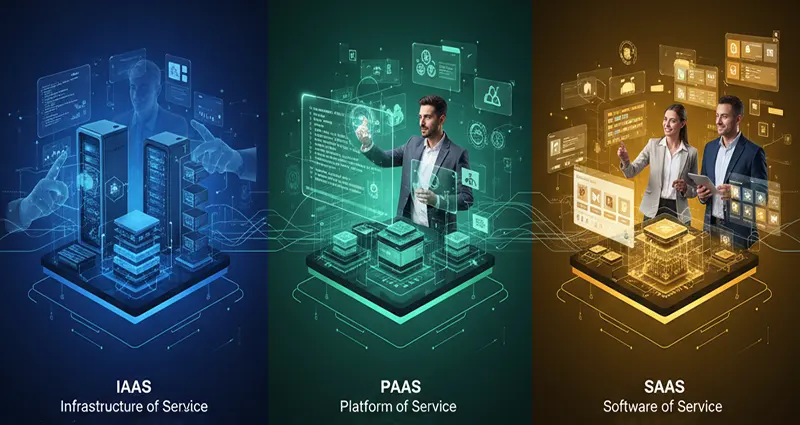
Cloud computing offers businesses a flexible, pay-as-you-go alternative to owning and maintaining on-premise IT infrastructure. To choose the right approach, companies must understand the three core cloud service models, often described as the “as-a-Service” continuum: Infrastructure as a Service (IaaS), Platform as a Service (PaaS), and Software as a Service (SaaS).
These models represent increasing levels of vendor management, giving businesses different trade-offs between control and convenience.
1. Infrastructure as a Service (IaaS)
IaaS is the most basic cloud service model, providing the fundamental building blocks for cloud IT. Think of it as renting the virtual equivalent of a data center.
What the Business Controls
The customer is given access to core computing resources over the internet, including:
- Virtual Machines (VMs): Computing power (vCPUs and RAM).
- Storage: Block, file, and object storage.
- Networking: Firewalls, load balancers, and virtual networks.
The customer is then responsible for installing, managing, and maintaining the Operating System (OS), middleware, applications, and data.
Benefits and Use Cases
| Benefit | Use Case |
| Maximum Control | Ideal for customized IT environments and legacy application migration where the business needs to select and manage a specific OS. |
| Flexibility | Allows for complete configuration control over the environment, network, and security settings. |
| Cost-Efficiency | Pay-as-you-go billing eliminates the huge upfront Capital Expenditure (CapEx) of buying physical hardware. |
| High Scalability | Perfect for workloads with unpredictable demand (e.g., e-commerce seasonal spikes, testing environments) that need rapid, granular scaling. |
| Examples: AWS EC2, Google Compute Engine (GCE), Microsoft Azure Virtual Machines. |
2. Platform as a Service (PaaS)
PaaS provides a ready-to-use development and deployment environment. It sits above IaaS by abstracting the complexities of the operating system and infrastructure management.
What the Business Controls
The provider manages the servers, storage, networking, OS, and middleware. The developers are responsible for their application code and the data that runs on the platform.
Benefits and Use Cases
| Benefit | Use Case |
| Accelerated Development | Developers can focus 100% on writing and deploying code, significantly reducing Time-to-Market for new applications. |
| Reduced Complexity | Eliminates the need for IT teams to manage patches, security updates, and server maintenance for the underlying environment. |
| Collaboration | Provides a shared, standardized environment that streamlines workflows for multiple developers working on a single project. |
| Cost-Effectiveness | The reduced management overhead makes it cheaper and simpler than managing a full IaaS stack. |
| Examples: AWS Elastic Beanstalk, Google App Engine (GAE), Microsoft Azure App Service, Heroku. |
3. Software as a Service (SaaS)
SaaS is the most widely adopted and simplest cloud model. It delivers a complete, fully functional software application over the internet, typically accessed via a web browser.
What the Business Controls
The end-user (the customer) only manages their own data and user access. The vendor manages everything else: the application, the runtime, the middleware, the OS, the servers, and the networking.
Benefits and Use Cases
| Benefit | Use Case |
| Zero Maintenance | No installation, setup, or patching is required. The provider handles all updates, security, and maintenance automatically. |
| Accessibility | The software can be accessed from any location and any device with an internet connection, ideal for remote work and collaboration. |
| Predictable Costs | Usually based on a simple subscription model (per-user/per-month), making it easy for budgeting. |
| Rapid Deployment | Applications are ready to use immediately upon subscription. |
| Examples: Microsoft 365 (Word, Excel), Salesforce (CRM), Google Workspace (Gmail, Docs), Dropbox. |
The Cloud Responsibility Spectrum (The Pizza Analogy)
Understanding the difference is often best visualized by looking at who is responsible for what. In the classic pizza analogy, hosting on-premises is like cooking the pizza from scratch (you manage everything), while IaaS, PaaS, and SaaS involve increasingly less customer responsibility:
| Service Model | You Manage | Provider Manages | Analogy |
| On-Premises | All layers (power, building, networking, OS, application, etc.) | None | Making the whole pizza at home. |
| IaaS | OS, Middleware, Runtime, Data, Applications | Networking, Storage, Servers, Virtualization | Ordering a pizza kit (You cook, everything else is provided). |
| PaaS | Data, Applications | OS, Middleware, Runtime, Networking, Storage, Servers | Ordering a delivery pizza (You eat, they make and deliver). |
| SaaS | Data (limited to configuration) | Everything (Application, OS, Servers, Data, etc.) | Ordering a pizza from a restaurant (You just show up and eat). |
By strategically mixing and matching these three cloud service models, businesses can optimize their IT investment, accelerate product delivery, and focus their internal resources on core competitive advantages.

It is not so easy to lead a certain group of students. In fact, it is more convenient for teachers Read more

Absolutely nothing has absolutely brought on additional changes on the planet than science and technologies. In fact, the advent of Read more

Laptop hardware refers to the many physical elements that make up a laptop. As an example, the motherboard, processor, challenging Read more

When arranging a computer system network installation ensure that you have the right technology to complete the job. Make certain Read more