
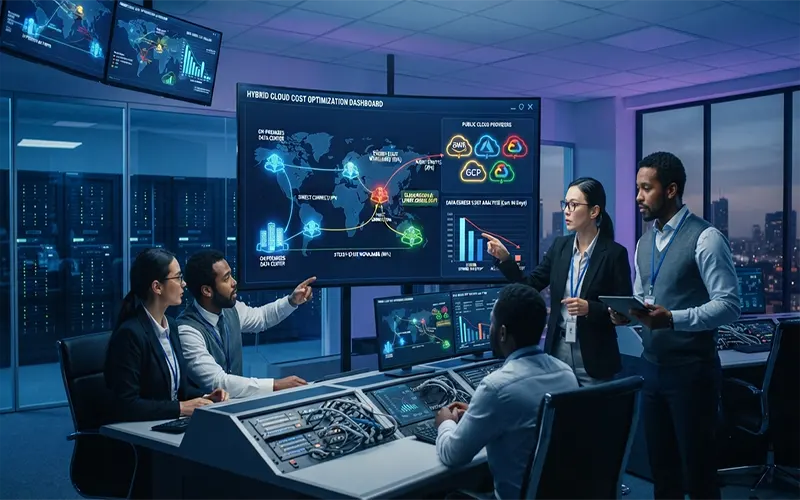
For many enterprise Chief Technology Officers, opening the monthly public cloud invoice brings a familiar kind of sticker shock. While public cloud providers offer unmatched elasticity for variable workloads, relying on them to host high-volume, predictable, steady-state operations introduces a silent financial drain: data egress fees.
Hyperscalers charge heavily to move data out of their ecosystems, across availability zones, or across geographic regions. For enterprises processing massive datasets, analytics pipelines, or media archives, these bandwidth tolls routinely erode profit margins. To regain control of runaway cloud expenditure, organizations are implementing strategic hybrid cloud architectures designed specifically to eliminate unnecessary egress charges and optimize steady-state workloads.
The Hidden Financial Trap of Public Cloud Data Egress
Public cloud adoption is governed by an asymmetrical pricing model: getting data into the cloud is typically free or inexpensive, but getting data out is aggressively monetized.
- The One-Way Tollbooth: Every time data is transferred from a cloud provider’s data center back to an on-premises facility, to a competing cloud, or across public internet routing, enterprises pay per-gigabyte egress fees.
- The Cost of Steady-State Monopolies: Running predictable, high-throughput applications entirely in the public cloud means you are paying continuous, premium infrastructure rates for compute and storage that never actually flex or scale. Over time, this makes public cloud hosting for steady-state workloads far more expensive than dedicated colocation or private infrastructure.
- Unpredictable Billing Spikes: A single unexpected data migration, backup restoration, or analytics export can trigger massive billing spikes, making accurate financial forecasting nearly impossible.
Architecting for Hybrid Efficiency: Core Components
A well-architected hybrid cloud model neutralizes egress costs by strategically aligning workload characteristics with the most cost-effective hosting environment.
- Workload Polarization: Separating elastic, bursty application layers (which benefit from public cloud auto-scaling) from predictable, high-volume steady-state core databases and raw storage repositories (which run cost-effectively on-premises or in colocation facilities).
- Dedicated Interconnects and Private Direct Links: Bypassing the public internet entirely by leveraging direct peering, AWS Direct Connect, Azure ExpressRoute, or carrier-neutral partner fabrics. These high-bandwidth private links offer flat-rate port pricing, drastically reducing per-gigabyte transfer costs.
- Edge and Local Caching Layers: Implementing regional caching and object-store gateways to minimize redundant cross-cloud data pulls and keep frequently accessed data local to the point of consumption.
A Step-by-Step Hybrid Architecture Implementation Framework
Transitioning to an egress-optimized hybrid infrastructure requires a structured, multi-phase technical and financial roadmap.
Step 1: Egress Audit and Data Gravity Mapping
Conduct a comprehensive data flow audit across your entire cloud footprint.
- Analyze where your data originates, how frequently it moves across boundaries, and calculate total monthly egress expenses broken down by individual cloud services and APIs.
- Identify high-volume data egress “hotspots” that contribute disproportionately to your monthly bills.
Step 2: Defining Workload Placement Policies
Establish clear architectural guidelines separating ephemeral compute from steady-state storage:
- Public Cloud Zone: Keep front-end web apps, microservices requiring sudden scaling, and development/testing environments.
- On-Premises / Colocation Zone: Anchor core databases, long-term archival storage, big data processing clusters, and predictable backend services.
Step 3: Establishing Secure, Low-Cost Interconnectivity
Provision dedicated high-speed private connections between your on-premises data centers and your public cloud regions. Optimize routing paths using multi-protocol label switching (MPLS) or software-defined WAN (SD-WAN) technologies to ensure reliable, encrypted, and cost-predictable data transit.
Step 4: Continuous FinOps Monitoring and Cost Guardrails
Deploy cloud financial management (FinOps) tools and automated alerting systems. Set hard budget caps and egress traffic alerts to track, analyze, and automatically reroute runaway traffic away from expensive public internet egress vectors.
Measurable Financial and Operational Impact
Adopting an egress-optimized hybrid cloud architecture yields profound bottom-line results:
- Drastic Reductions in Cloud Spend: Enterprises routinely slash monthly cloud bills by 30% to 50% simply by repatriating steady-state storage and eliminating per-gigabyte public transfer fees.
- Elimination of Billing Surprises: Shifting predictable data flows to flat-rate private interconnects restores financial predictability to IT budgeting.
- Enhanced Data Governance: Keeping core data repositories on-premises or in dedicated colocation facilities provides absolute control over data sovereignty and compliance postures.
Data egress charges are no longer an unavoidable cost of doing business in the cloud; they are an architectural inefficiency. By deploying a thoughtful hybrid cloud model that pairs public cloud elasticity for bursty workloads with dedicated, low-cost infrastructure for steady-state operations, enterprises can transform data movement from an unmanaged financial liability into a predictable engine for long-term growth.

It is not so easy to lead a certain group of students. In fact, it is more convenient for teachers Read more

Absolutely nothing has absolutely brought on additional changes on the planet than science and technologies. In fact, the advent of Read more

Laptop hardware refers to the many physical elements that make up a laptop. As an example, the motherboard, processor, challenging Read more

When arranging a computer system network installation ensure that you have the right technology to complete the job. Make certain Read more